
The ethical aspects that promote healthy ageing are shown in blue and those that undermine it in red.

Click on the specific Ethical aspects
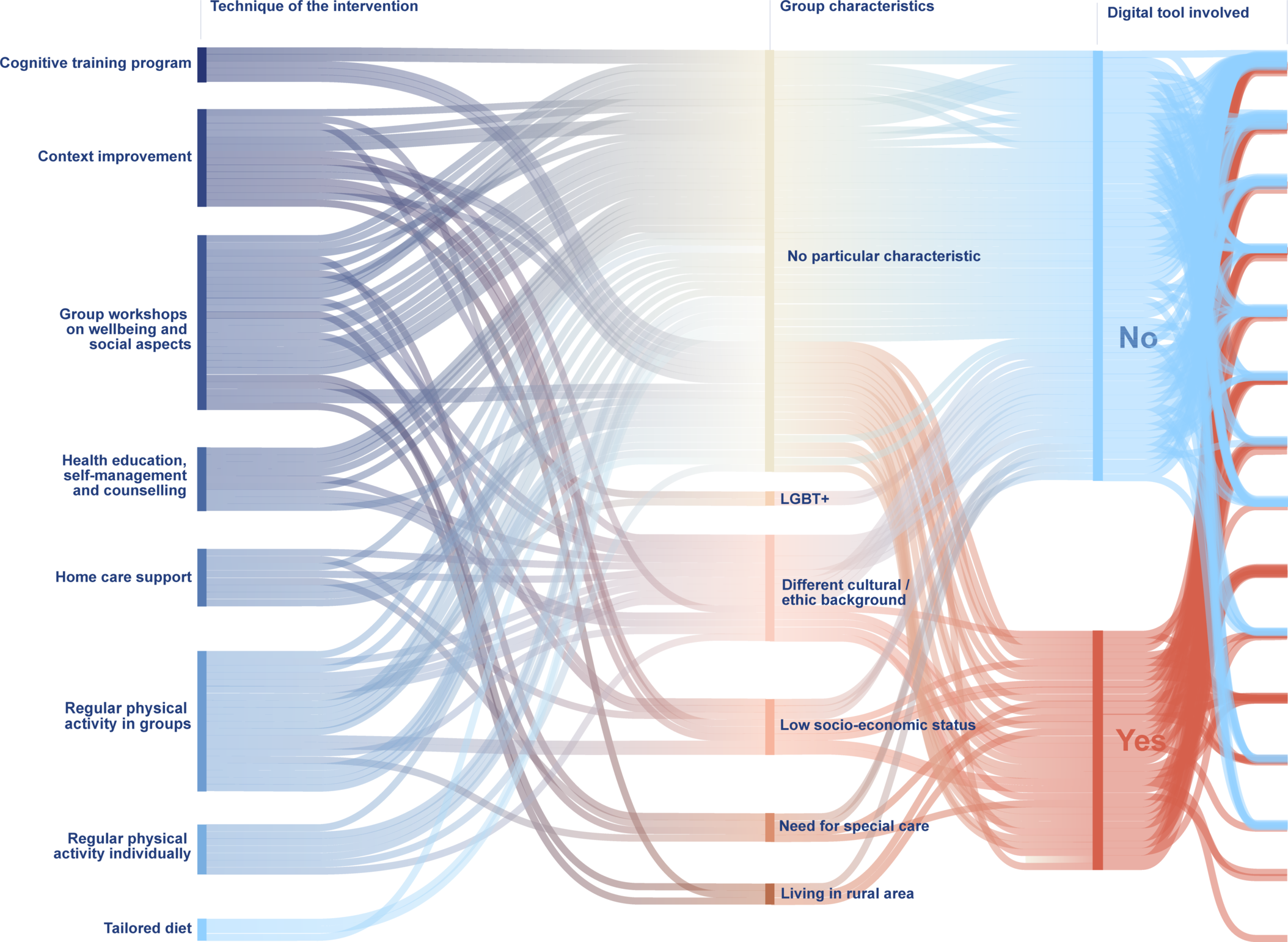
- ETHICAL ASPECTS
- Increasing social wellbeing
- Autonomy promotion
- Reducing health inequalities
- Community engagement
- Cultural sensitivity
- Improving access to healthcare
- Rational use of health resources
- Sense of self recognition
- Violation of personal data
- Responsibilization
- Amplifying health inequalities
- Person-centred care
- Mitigating stigma
- Reducing human contact
- Inhibiting autonomy
Some highlights:
Across all categories of interventions, four ethical issues were always present: increasing social wellbeing, autonomy promotion, improving access to healthcare and cultural sensitivity.
Conversely, mitigating stigma was an ethical issue that appeared in only one category of interventions: ‘Wellbeing and social aspects’.
‘Wellbeing and social aspects’, ‘Physical activity’ and ‘Context improvement’ were associated with the largest number of ethical aspects promoting healthy ageing.
The categories of interventions with the highest number of ethical aspects undermining healthy ageing were ‘Context improvement’, ‘Home care support’ and ‘Health and self-management education’.
Most of the ethical issues that undermine healthy ageing were associated with the use of digital tools.